
 Turnkey Inside
So you’ve probably heard about automated market makers in DeFi spaces like Uniswap, PancakeSwap, or even Curve. And maybe you wondered how these platforms manage to run non-stop without a traditional order book or centralized matching engine. That’s where it gets interesting.
Understanding what an automated market maker is doesn’t just help you become a better trader, it also opens your mind to how liquidity can work outside traditional systems like MT4, MT5, or even centralized crypto exchanges.
Read More: What is Smart Order Routing? Everything You Need to Know
And if you’re ever planning to launch a brokerage or integrate a DeFi-like structure, this becomes more than just a buzzword.
Automated Market Maker Explained
An automated market maker (AMM) is a protocol that allows digital assets to be traded in a decentralized way using smart contracts, instead of matching buyers and sellers via an order book.
In traditional finance, market makers are institutions or individuals that quote both buy and sell prices, profiting from the spread. They ensure liquidity and tighten spreads during normal market hours. You’ve seen this in centralized exchanges or inside forex platforms with liquidity providers quoting real-time prices.
In DeFi, however, there’s no one sitting behind a terminal updating quotes. AMMs use algorithms and liquidity pools instead.
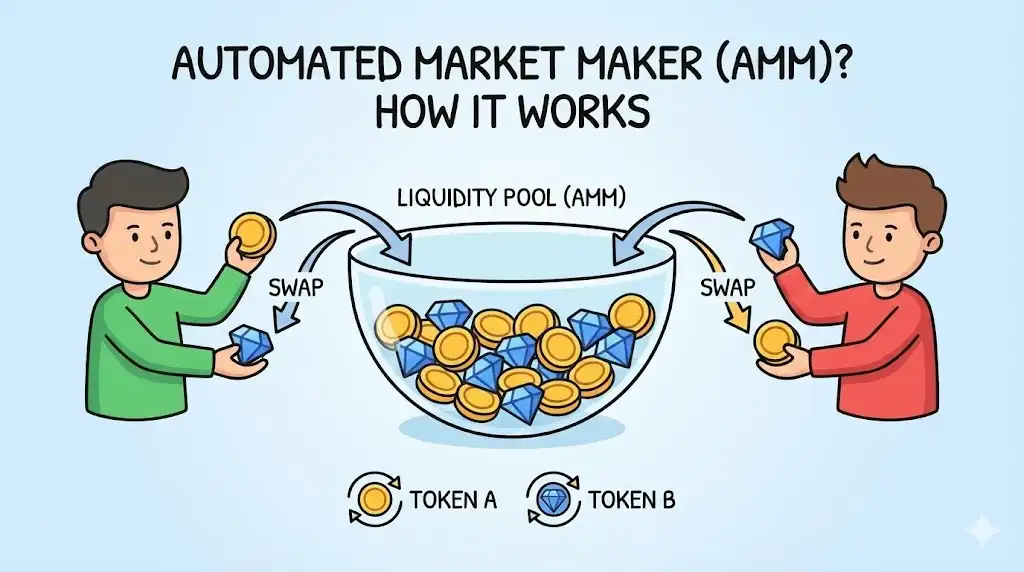
So here’s how it works: users (liquidity providers) deposit tokens into a liquidity pool, and traders can swap between those tokens using the AMM’s algorithm. Prices adjust automatically based on how much of each token is in the pool.
How an Automated Market Maker Actually Works
At its core, an AMM is just a piece of code. It is a smart contract on a blockchain, usually Ethereum, that holds funds. Instead of matching buy and sell orders, the AMM uses a mathematical formula to price assets.
Users trade directly with a pool of assets. This pool is known as a Liquidity Pool. Think of it as a big bucket containing two different tokens.
Most AMMs operate on a simple math formula to determine pricing. The most widely used is:
x * y = k
Here’s the breakdown:
x = amount of Token A
y = amount of Token B
k = constant (total value locked remains constant)
So every time you buy or sell one token in the pair, the balance changes and the price adjusts accordingly. It’s self-regulating. And the more liquidity a pool has, the less price impact there is when you make a large trade.
Say you’re swapping ETH for USDC. If there’s $10 million of liquidity, your $1,000 swap barely moves the price. But if the pool only has $10,000, even small trades shift pricing dramatically.
That’s slippage, and AMMs don’t prevent it, they just function differently from centralized exchanges where bids and asks are lined up in an order book.
Types of Automated Market Makers
Not all AMMs use the same formula. Different assets require different approaches. Developers have created specialized variations to handle specific trading needs.
1. Constant Product Market Maker (CPMM)
This is the classic model I just described (x * y = k). It is popularized by Uniswap V2. It works well for most volatile assets.
It ensures that there is infinite liquidity. The price can go to infinity or zero, but the pool will never run completely dry.
2. Constant Sum Market Maker (CSMM)
This model uses the formula x + y = k. It is ideal for assets that should have the same price. However, it has a flaw.
If the outside market price changes, traders can drain the entire pool of one asset. It does not provide infinite liquidity.
3. Hybrid Automated Market Makers
Curve Finance is the best example here. It combines the constant product and constant sum models. It is designed specifically for stablecoins (like USDC and DAI) or wrapped assets (like wBTC and renBTC).
Since these assets should theoretically trade at a 1:1 ratio, the curve is much flatter. This allows for extremely low slippage even on huge trades. It is why traders prefer Curve for swapping stablecoins over Uniswap.
Automated Market Makers vs Order Book Models
Order books rely on limit orders placed by participants. Depth comes from active quoting. This works well in mature markets but struggles during low participation periods.
Automated market makers provide continuous liquidity. There is always a price, even during low activity. This reliability is appealing, but it comes at the cost of slippage.
In fast markets, AMMs may lag behind real price movements. Arbitrage fills the gap, but delays exist. Order books react instantly when liquidity is present.
Hybrid models are emerging, combining AMM logic with order books. These aim to balance stability and efficiency. This is an area worth watching closely.
Relevance of AMMs to Forex and Brokerage Infrastructure
You might wonder why automated market makers matter to forex brokers. After all, forex markets are deep and liquid.
However, internal matching, B-book models, and synthetic liquidity pools already resemble AMM logic in some ways. Pricing engines adjust quotes based on exposure, not just external feeds.
Some brokers experiment with internal liquidity pools where client flow is matched algorithmically. While not decentralized, the principle overlaps with AMM thinking.
Understanding AMMs helps brokers design better risk systems. It also opens doors to offering new products, especially tokenized assets or hybrid trading instruments.
Read More: Prop Firm Challenge: How It Works + Tips to Pass on First Try
Final Thoughts
The automated market maker is a brilliant piece of engineering. It solved the liquidity problem for decentralized assets. It allows anyone to create a market for any token without asking for permission.
The financial world is evolving rapidly, from traditional forex to cutting-edge AMM technology. Don’t just watch the industry change from the sidelines. Turnkeyinside empowers you to launch your own brokerage with ease.
Whether you want to offer Forex, CFDs, or integrate crypto solutions, we provide the complete infrastructure you need to succeed. Our white-label solutions are secure, scalable, and ready to deploy.
