
 Turnkey Inside
When markets fragment across multiple liquidity sources, routing becomes more than a technical detail. It decides where your order goes, how fast it gets filled, and at what price.
Many traders blame slippage or bad fills on market volatility, but often the real issue sits inside the routing logic. Understanding this concept gives you a different perspective on execution quality.
Read More: Alternative Trading Systems (ATS): How They Work & Benefits
This guide explains smart order routing in practical terms, with real use cases, common mistakes, and why it matters so much for brokers and traders alike.
Smart Order Routing Meaning Explained
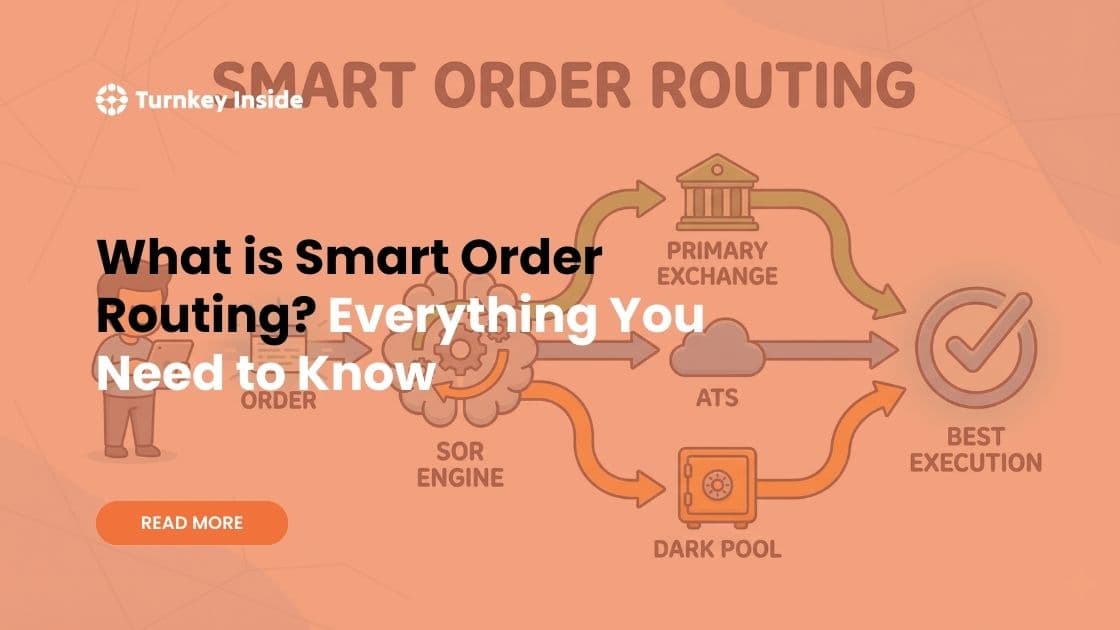
Smart order routing meaning refers to an automated process that decides how and where a trading order is executed across multiple liquidity sources. Instead of sending an order to a single venue, the system evaluates several options and routes the order based on predefined criteria.
These criteria can include price, available liquidity, execution speed, historical performance, and risk exposure. The goal is simple in theory. Achieve the best possible execution for each order. In practice, the process is far more complex.
Smart order routing is widely used in equities, forex, and CFD markets. Any environment with multiple liquidity venues can benefit from this approach.
How Smart Order Routing Works in Practice
Here’s what’s happening under the hood when you press that “buy” or “sell” button and a smart order router is involved:
- Order is received by the brokerage or trading platform.
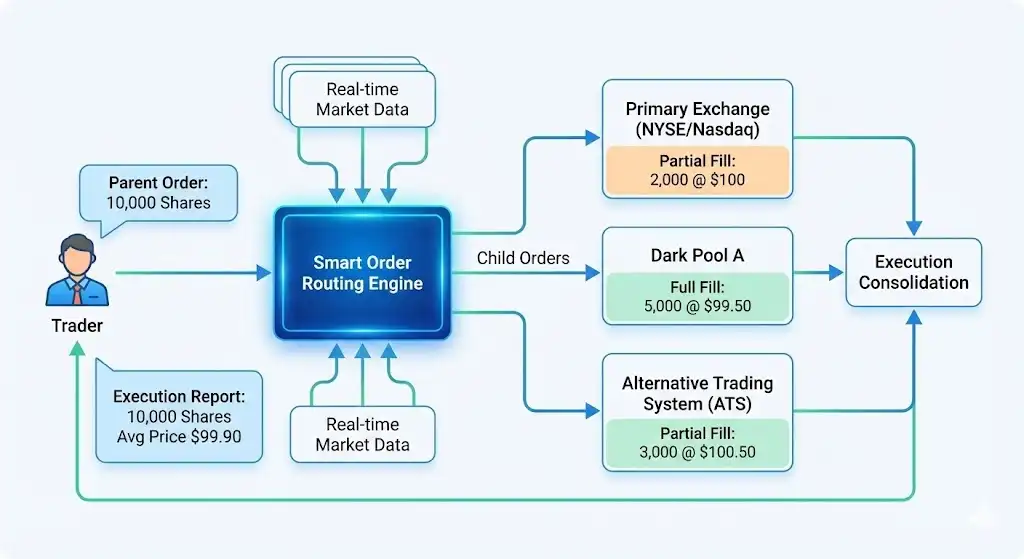
- Routing logic kicks in, scanning multiple liquidity providers (LPs), ECNs, or exchanges in milliseconds.
- The best price is selected, but not just based on bid/ask. Other variables like latency, fill ratios, and slippage history are also considered.
- Order is split (if needed) and routed to one or more venues.
- Confirmation comes back and your trade is filled, hopefully faster, and at a better rate.
Pretty slick, right? And the best part, it’s invisible to the trader. But behind the scenes, a lot is going on, and that logic can be custom-tuned depending on the broker’s needs.
Why Smart Order Routing Matters for Brokers
Here’s the truth most people don’t talk about: routing poorly = lost clients.
If your brokerage sends trades to the wrong venue (bad spreads, slow execution), traders will feel it. They might not know exactly what’s wrong, but they’ll notice slippage, requotes, and slow fills. That’s when they leave.
Good smart order routing solves this. It keeps execution fast, competitive, and transparent, especially in volatile markets like NFP releases or during crypto weekends.
Also, brokers using SOR systems can tap into multiple liquidity providers at once without overloading their infrastructure. This gives them better pricing depth, more stable order books, and even protection against single-LP outages.
Types of Smart Order Routing Algorithms
Not all routers think the same way. Different situations call for different strategies. As a broker, you often have to configure these settings based on what your client wants.
1. Aggressive (liquidity taking)
This strategy is for when a trader wants to get in now, regardless of the cost.
The algorithm will scan for the best available ask prices across all exchanges and hit them immediately. It prioritizes speed and fill rate over price improvement.
2. Passive (liquidity providing)
This is for the patient trader. The SOR will post limit orders on various exchanges to try and capture the spread. It places the order on the bid and waits for a seller to come to it.
This is riskier because the market might move away, but it is cheaper because you often get maker rebates instead of paying taker fees.
3. Dark Aggregation
This algorithm specifically hunts for liquidity in non-displayed venues (dark pools).
It will ping these pools to see if there is a hidden seller, trying to get a large order filled without tipping off the public market.
4. Sweep to Fill
This is a common one. The router looks at the entire order book across all venues and sweeps up through the price levels until the order is complete.
It effectively calculates a generic Volume Weighted Average Price (VWAP) for the immediate execution.
Smart Order Routing Algorithms: What They Actually Do
Some focus only on best price (lowest ask or highest bid). Others optimize for execution cost, meaning they take into account fees, rebates, and latency.
Here are a few common routing strategies used by modern brokers:
- Price-time priority: Route to the best price with the fastest timestamp.
- Pro-rata distribution: Split the order proportionally across venues offering similar prices.
- Cost-based routing: Choose venues with lower transaction costs, even if price isn’t the best.
- Fill ratio optimized: Prioritize venues with the highest probability of complete fills (less partials).
- Latency-aware routing: Route based on geographical proximity or known latency metrics.
In some cases, the algorithm even learns from previous trades. If a certain LP fails to fill or causes frequent slippage, the router starts avoiding it. That’s where machine learning is being layered into modern SOR systems.
Using Smart Order Routing to Boost Your Brokerage
If you’re running or launching a forex brokerage, SOR isn’t just nice to have, it’s a serious advantage.
You can advertise tight spreads and fast execution all day, but without smart order routing behind it, it’s just marketing. Traders these days are more sophisticated. They notice the difference between 5ms and 300ms. They track execution quality. Some even compare fills between brokers. So if your infrastructure can’t back it up, they’ll move on.
Most modern MT4/MT5 bridge providers now offer SOR built-in, but the configuration matters. You’ll want a partner who understands how to fine-tune it based on asset class, client segmentation, and LP quality.
Read More: What Is a Broker-Dealer? Definition, Types & How They Work
Start Your Own Forex Broker with TurnkeyInside
At TurnkeyInside, you can start your own forex broker with a complete turnkey solution that includes advanced smart order routing algorithms, deep liquidity access, and professional risk management.
From platform setup to execution infrastructure and compliance support, everything is designed to help you operate with confidence from day one.
If building a serious brokerage is part of your plan, TurnkeyInside provides the structure and technology to do it properly.
